Tuesday, 28 July 2015

Compact Cameras: Fuji X100T and Panasonic GM1 from Mark Farrington

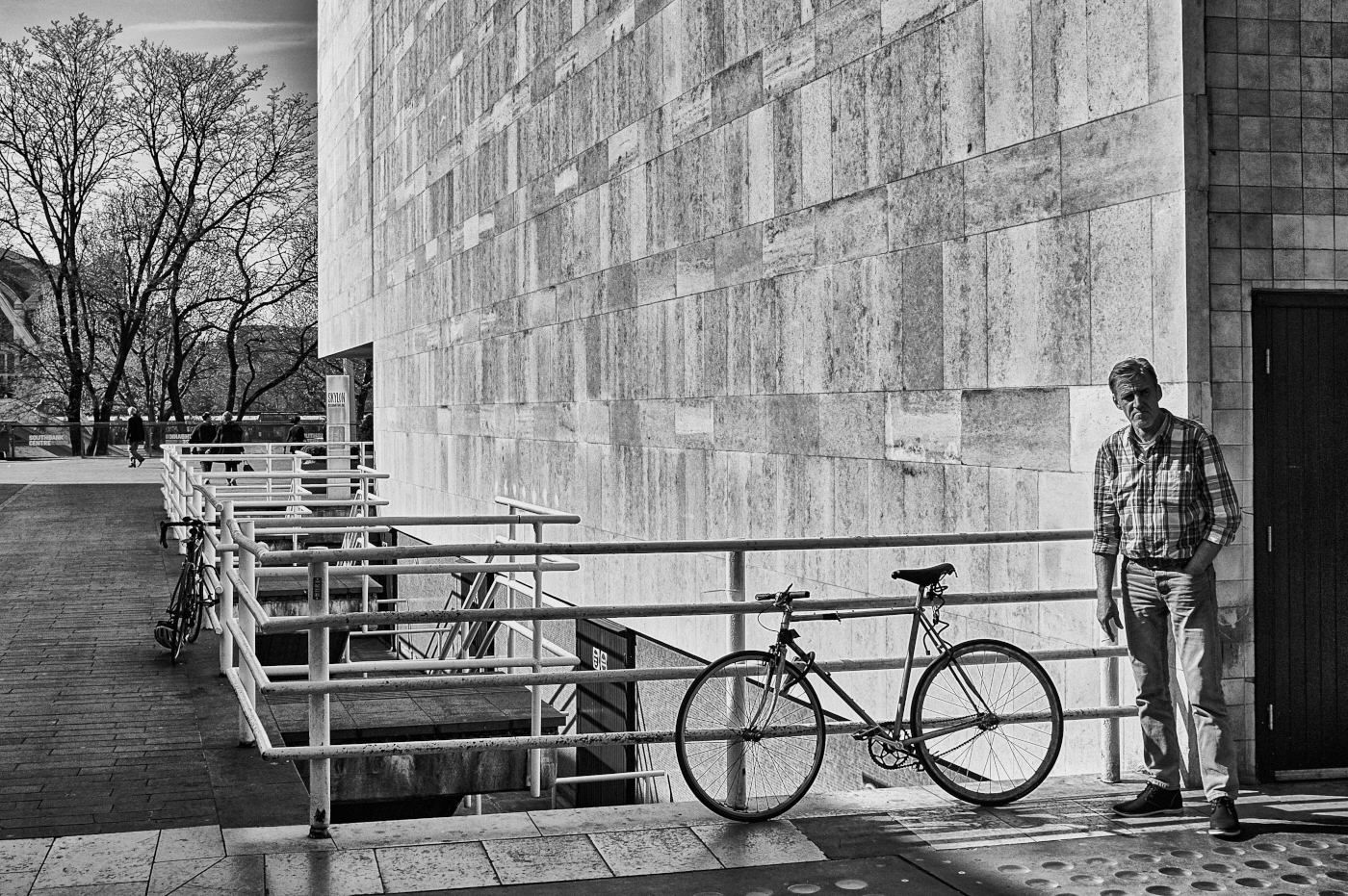
I prefer these two cameras even to my Olympus OMD for photographing in the street: the smaller your camera the less you look like a photographer, and I just feel a lot less conspicuous and more relaxed doing it. People mostly ignore you, especially in touristy areas. With the Fuji you soon learn the fixed field of view (35mm full frame equivalent, f2.0) and you zoom with your feet. It feels very well made, handles pretty well, has an APSC sensor and gives reasonable results up to 3200ASA, but there's no image stabilization. The viewfinder's great for manual focussing, but I mostly rely on auto focus and shoot bursts of a few frames at 4fps when things look right. That copes with people blinking or having their hand momentarily obscuring their face. It's all nicely hair-shirt!
The GM1 looks just like a Point-and-Shoot, but has the same sensor as the midrange micro 4/3 mirrorless bodies. It has really fast single AF, markedly quicker than the Fuji, so is great for shooting from the hip or above your head. It has image stabilised interchangeable lenses from Panasonic (and all the Olympus lenses fit). I don't go above ASA1000. No viewfinder, but focus-and-shoot from the touch sensitive screen is really fast. It's very small with 'enthusiast' controls, so changing settings is a fiddle compared with the Fuji. Also aiding 'invisibility' for the photographer, both cameras have iPhone apps that let you shoot while it looks as though you're texting on your phone, and they have silent electronic shutters.


Thursday, 16 July 2015

Aperture Meeting Thursday 23rd July

We meet next Thursday 23rd July at Foxton Village Hall. All Members including new Members are welcome - at Aperture we look outside the club competition scene and encourage members to work on their own projects, books, exhibitions etc, and/or to prepare for RPS or PAGB distinctions (in no way compulsory).
We will start with any distinction and project work - either panels especially if you are preparing for the September LRPS assessment or digital files if you want help with choosing images (provide up to 30 images for a quick review of their suitability) or advice on a project.
Following on from last month's discussion on system cameras, this month we have two topics 1) Compact Cameras: 2) Travel and Street photography. Please bring along your compacts to compare and send me any comments you have about your camera with examples of images. As their main use is normally for street and travel photography, we will also have a discussion on the what cameras are best (compact,system,SLR) and any tips from seasoned travellers would be very welcome.
Ian is away this month so please could you send images in advance to Chris Fell (intcompsec@cambcc.org.uk) or arrange to share a dropbox if you can use this facility.
More information at: http://apertureccc.blogspot.co.uk/
Contact: Ann Miles
Email: ann@pin-sharp.co.uk
Phone: 07710383586

Saturday, 4 July 2015

Fuji Manual Focus and Focus Checking

This was originally contained in a reply to another entry, but I'm re-posting it: (a) because it's really useful; and (b) to test that I now have publish permissions for the Aperture blog!

Another set of useful Fuji tips relating to manual focus and critical focus checking.

(1) Set the camera to "RAW+JPEG" even if you intend to throw the JPEGs away later. If you shoot RAW only, the maximum magnification is about 1/3 size (i.e. it's limited by the preview JPEG which is embedded in the RAW file). Shooting RAW+JPEG allows captured pictures to be viewed at 100% magnification.

(2) The "Focus Assist" button zooms the viewfinder/screen to 100% to help with checking critical focus at the taking stage. There's a really useful option (Spanner 1, Screen Set-Up, Focus Check) which enables this behaviour automatically when switching from auto to manual focus.

(3) In playback mode, the "Focus Assist" button zooms the picture to 100% for critical focus checking, with the displayed image being centred at the focus point.

Friday, 3 July 2015

System Cameras (11) OlympusE- M1 (Diana Moss)

(Apologies, I left this one out of the original postings - please make comments if you can give any suggestions to why Diana is not happy with some aspects of her camera)

Purchased Olympus EM-1. very recently. with a view to replacing the 5D Mk11.

Disappointed with initial results considering its sold as all singing/all dancing.
Major concerns graininess and softness.

Graininess: An experiment with a static wheelie bin, cameras in turn on a tripod and as far as I could, equivalent settings using equivalent lenses.
All the printing parameters were the same.
Conclusion: Hardly any difference, although I think the Olympus is slightly more ISO sensitive.
However given a sunny evening and hand held I was really pleased with the technical aspect of the attached image. It has been through Fx Pro.
Softness: The jury is still out, but perfectly willing to accept that my camera technique or camera settings could be better chosen.


I would be grateful for any feedback from the meeting.

A group of us at Bedford are getting together with an Olympus rep to discuss 'issues' shortly. If CCC Olympus users have Qs I will endeavour to get them answered - please feel free to hand on my e mail address. It is in a private house so I can't make it an open invitation.

Monday, 29 June 2015

System Cameras Reviews (10) - Further Thoughts on Olympus E-M1 from Clive

I wasn’t too sure about the image quality until I found a comment on a Olympus forum that advised on Lightroom settings, in particular reducing the Sharping Radius to 0.5. The Lightroom default radius is 1.0. This greatly improved the look of the image. 
I believe you do need the quality glass i.e. the primes & the Pro zoom, to really appreciate the format. Since owning the 40-150mm 2.8 pro lens, I am really sold on the system. It is a great lens to use and produces really sharp images.

My Pros & Cons-
Pros
Compact size, less weight, easy to run 2 bodies at once, with different lens on
Does not look like a 'Pro’ camera
Can see the effects of changing exposure & colour balance in the viewfinder
After taking the image, there is a brief preview in the viewfinder, which confirms what you have got. 
Cost is lower than the big players (Canon & Nikon)
Fully weather sealed
Fn buttons on the Pro Lens lock the focus 
An effective manual clutch on the some lens, allow you to switch quickly between manual & auto focus
Focus Peeking
Wireless  - can use a phone as a remote
Highly configurable, disadvantage to some but to me it is a big plus
Wide range of lens. Panasonic shares the same format, therefore the lens & bodies are interchangeable
Firmware updates that add improvements not just fixes
Amazing Image Stabiliser ensures sharp images and  allows really low shutter speeds to be used handheld

Cons
High ISO, though the increased depth of field from the format allows you to open up the lens more
Battery life can be poor, though I did get 500+ images on one battery at a recent event, but generally I get a lot less
Continuous focusing, not bad but needs improvement

Future development 
Olympus Road Map there are bringing out new pro lens - in particular a 300mm f4 telephoto (600mm in full frame). With the 1.4 converter it will be 840mm f5.6! 
The new 40mg size image functionality will be available in higher shutter speeds.

Sunday, 28 June 2015

System Camera Reviews (9) Fuji X-T1 (Phil)

I began my Fuji acquaintance with the fixed-lens X100 and was so impressed with the jpegs that I bought an X-Pro1 with a couple of prime lenses on offer.  The X-T1 followed with its superior EVF and tilting rear screen, but I still prefer the Pro1 for handling, though it's hardly compact or even light.  The lighter T1 comes with a dinky little flash unit that operates from the camera's own battery, and I have a Metz C20 flash for use with the Pro1.    

Most of the kit has been acquired second-hand, and the Fuji lenses can absorb a lot of punishment - I dropped the 55 - 200mm zoom on its mount end onto a pavement, and it showed no damage or malfunction.  The prime lenses are very sharp and have real aperture rings, where the variable f-stop zooms require you to check the aperture on the rear screen (the fixed aperture zooms, which are expensive, have a marked ring).  I have used two Samyang lenses with the Fujis - the 8mm f/2.8 fisheye and the current 12mm f/2 (=18mm).  They are very compact with excellent sharpness and contrast, and are cheap compared to the Fuji equivalents (there is no Fuji fisheye yet) but do not give you any metadata and have to be fired with the 'no lens attached' box ticked in the menu. They have to be used in manual or aperture-priority mode.

This is no drawback, but I have one grumble about the T1: when you choose 2 or 10 second self-timer in the menu, it lasts only as long as you use it.  If the camera goes to sleep, you have to reselect and set it again.  Certainly it never catches you out like Canon, when you come to shoot an instant pic and find that the self-timer is set, so perhaps I shouldn't grumble.  The Pro1 takes a threaded remote shutter release, avoiding all the self-timer hassle, whereas the T1 does not.  The filter sizes are different for all the lenses.

To sum up, not the smallest CSCs in the world but no bigger than the Olympus OM-1 of old.  Big sensor with enlargement pixel for pixel as good as the Canon 5D Mk. 3.  Not the best for action photography yet, but can be used for sport and nature (see Miles Whitworth's images).  Autofocus is slow, though perfectly suited to a more measured style of photography.  

X-T1 with Samyang 12mm 1/70th @ f/8 iso 640.  RAW image, not much processing needed.

X-T1 with 55 - 200mm zoom in single shot mode at 80mm 1/320th @ f/10 iso 200


X-E1 with 18mm Fuji prime


 X-Pro1 with 55-200mm + 16mm extension tube and fill-in flash.  1/125th @ f/14 iso 200 handheld

X-T1 with 55-200mm  1/320th @ f/8 iso 640.


System Camera Reviews (8) Fuji X-T1 (Ann)

For my contribution, here are some comparisons between Canon 5DIII with 16-35mm lens (left) and the fuji X-T1 with a 10-24mm (right).